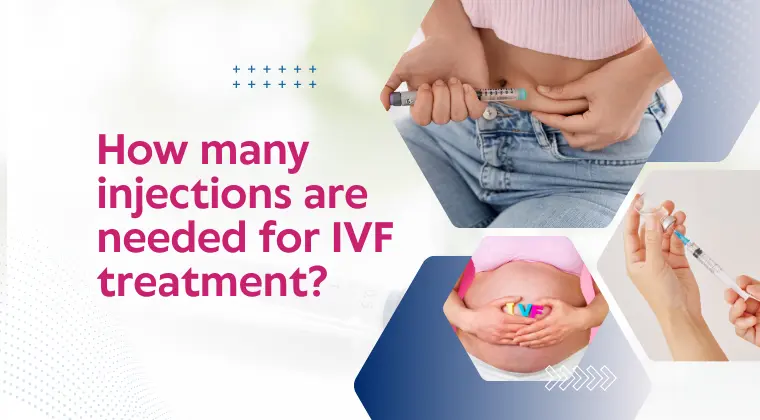
If you’re researching “How many injections are needed for IVF treatment?”, you’ve probably noticed something confusing: some people mention 10 injections, while others talk about 30 or more. This vast difference isn’t because someone is wrong; it’s because IVF works differently depending on your situation.
Let’s clear up this confusion in a way that actually makes sense.
Why the Number Keeps Changing
The reason injection numbers vary so much is simple: IVF isn’t just one treatment. There are different types of cycles, and each type requires a different approach.
Think of it like planning a journey. Sometimes you need to book both the outbound and return flights together. Other times, you only need to book the return flight because you already took the outbound one months ago. Same destination, different planning.
IVF works the same way.
What IVF Is Actually Trying to Do
To understand injections, you first need to understand what IVF is doing inside your body. There are two main jobs:
First: Collecting eggs from your ovaries (this requires helping your ovaries produce multiple eggs at once)
Second: Preparing your uterus to receive and support an embryo (this requires creating the right hormone environment)
Here’s the key point: these two jobs don’t always happen in the same month.
When both happen at the same time, you need more injections. When only one happens, you need fewer.
The Two Main Types of IVF Cycles
Fresh IVF Cycle
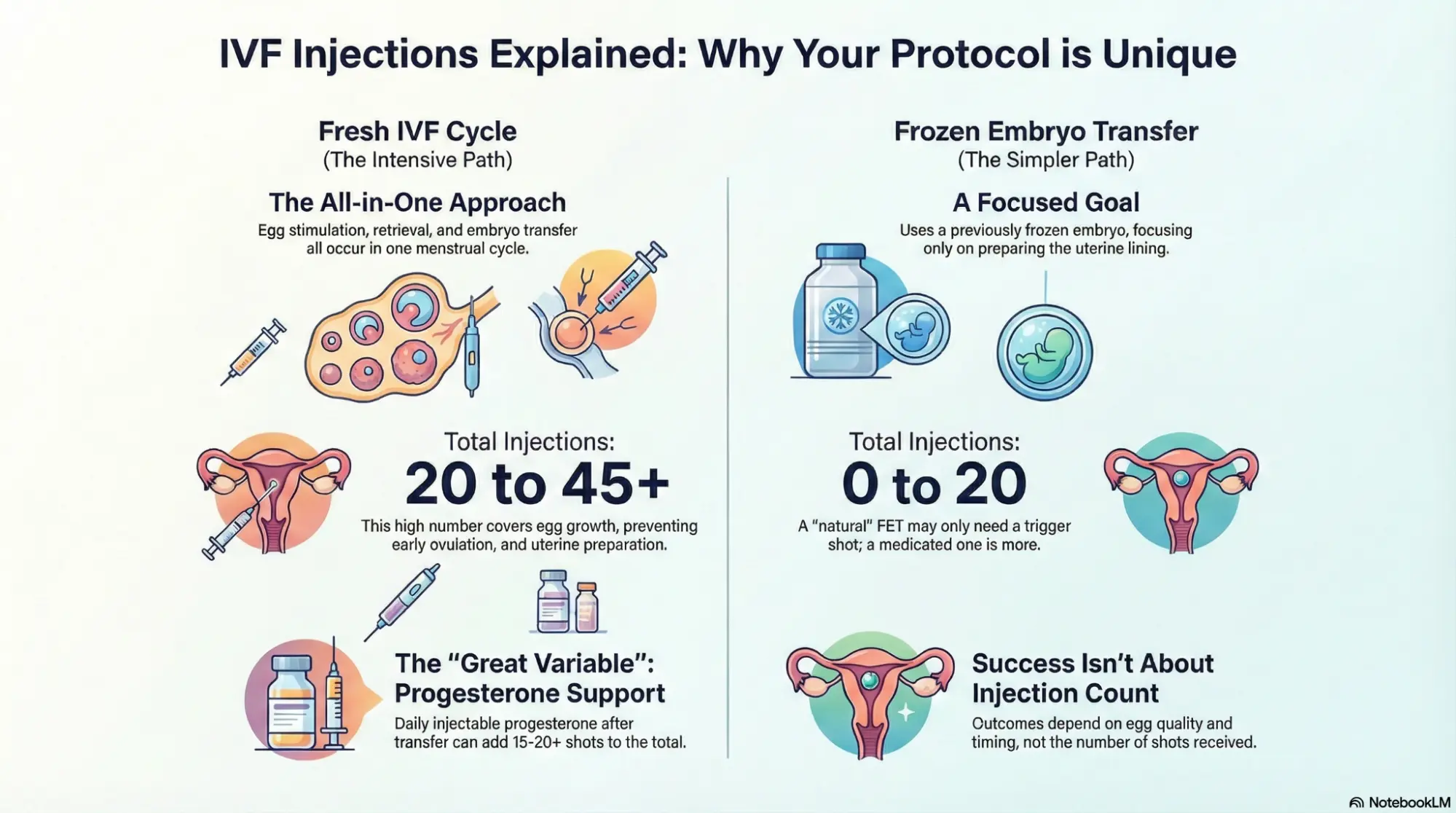
In a fresh cycle, everything happens in one go. Your doctors will stimulate your ovaries to produce eggs, collect those eggs, fertilise them in the lab, and then transfer a fresh embryo back into your uterus, all within the same menstrual cycle.
Because your body is doing both jobs at once, this type requires more frequent hormone injections to control the process carefully.
Frozen Embryo Transfer (FET)
In a frozen cycle, the egg collection already happened weeks or months earlier. The embryos are sitting safely frozen in the lab. Now, your doctors only need to prepare your uterus to receive one of those frozen embryos.
Since there’s no egg stimulation, this typically requires fewer injections. Sometimes it needs none at all.
This explains why your friend might have needed only 10 injections while someone else needed 35; they were likely going through different types of cycles.
Breaking Down Injections in a Fresh IVF Cycle
Fresh IVF happens in stages, and each stage may require injections. Let’s walk through them. Research published by ASRM shows that conventional IVF protocols use controlled ovarian stimulation with gonadotropins to develop multiple eggs.
Stage 1: Growing Multiple Eggs (8-14 Days of Injections)
Normally, your ovaries release just one egg each month. For IVF to work well, doctors need to collect several eggs at once. This improves your chances of getting healthy embryos.
To make this happen, you’ll receive daily hormone injections called gonadotropins. These medications contain follicle-stimulating hormone (FSH) and luteinizing hormone (LH), hormones your body naturally produces in higher-than-usual amounts. You’ll take these injections just below your skin every day for about 8 to 12 days.
Gonadotropin doses typically range from 75 to 450 International Units (IU) daily, with most IVF patients receiving 250-450 IU per day. Your doctor will monitor you with ultrasounds and blood tests every few days to see how your follicles are growing. Based on what they know, they might adjust your medication dose.
How many injections: Typically 8 to 28 injections, depending on how long stimulation takes
This is why the exact number can’t be predicted in advance; it depends on how your body responds.
Stage 2: Preventing Eggs from Releasing Too Early (5-10 Days)
While your follicles are growing, your body might naturally try to ovulate and release those eggs before the doctors can collect them. If this happens, the entire cycle will be cancelled.
To prevent this, you’ll receive additional medications called GnRH antagonists or agonists, which block your body’s natural ovulation signal. GnRH antagonist medications are typically added around day 5 of stimulation, or when your lead follicle reaches about 14 millimetres in size.
How many injections: Typically 5 to 10 injections
Not everyone needs the same duration here. It depends on how quickly your follicles are maturing.
Stage 3: The Final Trigger Shot (Always 1 Injection)
Once your eggs are almost ready, you’ll receive one final injection called the “trigger shot.” This injection completes the final maturation of the eggs, preparing them for collection.
The timing is crucial; your egg retrieval procedure must happen exactly 34 to 36 hours after this injection. This precise timing ensures that eggs are retrieved when they’re mature but before they’re naturally released from the ovaries.
How many injections: Always 1 injection
Your clinic will give you a particular time for this injection, down to the exact hour.
Stage 4: Supporting Early Pregnancy (0-20+ Injections)
After your eggs are collected and fertilised, and an embryo is transferred back into your uterus, your body needs a hormone called progesterone. Progesterone prepares the uterine lining and supports early pregnancy.
Here’s where the biggest variation happens: some clinics use progesterone injections, while others use vaginal suppositories, gels, or tablets.
Studies have shown that progesterone injections are equivalent to vaginal progesterone suppositories in fresh IVF cycles when it comes to live birth rates. However, clinic preferences vary based on their protocols and patient needs.
If your clinic uses injections, you’ll need them daily for at least 10 to 14 days until your pregnancy test. If the test is positive, you might continue them for several more weeks until the placenta takes over progesterone production at around 8 to 10 weeks of pregnancy.
How many injections: Between 0 and 20+ injections, depending on your clinic’s protocol
This single decision, injectable versus non-injectable progesterone, can easily add or subtract 15 injections from your total count. That’s why comparing numbers with other patients can be so misleading.
Total Count for Fresh IVF
When you add up all four stages, most patients receive:
- Lower range: 15 to 20 injections
- Most common range: 20 to 35 injections
- Higher range: 35 to 45+ injections
All of these numbers are within normal limits. The variation simply reflects how your body responds and which medications your clinic chooses.
Injections in a Frozen Embryo Transfer Cycle
Frozen cycles are much simpler because the hard part, growing and collecting eggs, has already happened. Now the focus is purely on preparing your uterus.
Natural or Minimal Medication Cycle (0-2 Injections)
Some women have very regular menstrual cycles. In these cases, doctors can work with your body’s natural hormone production. Your body will ovulate naturally, and the embryo transfer is timed around that.
You might receive just one trigger injection to time ovulation precisely, or you might not need any injections at all.
How many injections: Usually 0 to 2 injections
This surprises many patients who assume IVF treatment always means lots of injections.
Medicated Frozen Transfer (10-20 Injections)
If your cycles are irregular or your doctor needs precise control over timing, you’ll take medications to prepare your uterus. You’ll usually take estrogen pills or patches starting on day 2, 3, or 4 of your menstrual cycle to help thicken your uterine lining.
Research suggests that, for optimal timing, day-3 embryos should be transferred on the 3rd or 4th day of progesterone administration, while day-5 or day-6 blastocysts should be transferred on the 5th or 6th day of progesterone administration. This means progesterone is typically started 3 to 6 days before your scheduled transfer.
Unlike in a fresh IVF cycle, where your body makes some progesterone, in most frozen embryo transfer cycles, your body does not make any progesterone, so the medication serves as a complete replacement. This is why some clinics prefer progesterone injections for FET cycles to ensure adequate levels.
If progesterone is given as injections, you’ll need them daily for 10 to 14 days until your pregnancy test.
How many injections: Typically 10 to 20 injections
Even at the higher end, this is still far fewer than a fresh IVF cycle.
Still Feeling Confused or Overwhelmed?
Download Our Patient Guide
“Understanding Your Treatment Plan. Without the Fear.”
This short, easy-to-read guide explains why treatment plans vary, what actually matters, and how doctors decide what is right for your body.
Inside the guide, you will learn:
- Why treatment numbers differ from patient to patient
- What parts of the protocol are fixed, and what can change
- Which decisions truly affect outcomes, and which don’t
- The right questions to ask during your consultation
This resource is meant to reduce anxiety, not add more information overload.
[Download the Free Guide]
Link: https://drive.google.com/file/d/1JRJzQ0E5XuC6ASCmdFXXF3ZE50K6O0wb/view?usp=sharing
Why We Can't Give an Exact Number of Injections Needed for IVF Upfront
You might feel frustrated if we can’t tell you exactly how many injections you’ll need. But there’s a good reason for this uncertainty.
The number depends on factors that can only be determined during your cycle:
- How quickly your ovaries respond to stimulation
- Your hormone levels during monitoring appointments
- Whether you need adjustments to medication doses
- What type of progesterone does your clinic use?
- Whether you’re doing a fresh or frozen transfer
Your treatment is customised based on what your body tells doctors through scans and blood tests. This personalisation is actually a good thing; it means your care is being tailored specifically to you.
What Matters More Than the Number
It’s natural to worry about injections, especially if you’re uncomfortable with needles. But here’s what’s important to remember:
More injections don’t mean worse fertility or a more serious problem. They simply mean your protocol requires more medication support.
Fewer injections don’t mean weaker treatment. They tell you that your situation allows for a more straightforward approach.
The injection count reflects how personalised your cycle is, not how well it will work.
IVF success depends on egg quality, embryo development, and proper timing, not on how many injections you receive. A patient who needs 20 injections isn’t at any advantage or disadvantage compared to someone who needs 40.
The One Question That Actually Helps
Instead of asking, “How many total injections will I need?” try asking:
“Will my progesterone support be given as injections or in another form?”
That single answer will explain most of the variation you’re seeing when you compare notes with others online or in support groups.
A Final Word on Injection Anxiety
If you’re worried about giving yourself injections, know that you’re not alone. Most IVF patients feel this way at first. The good news is that the needles are much smaller and less painful than most people expect, and you’ll receive thorough training from your clinic’s nursing staff.
Many patients report that within a few days, the injections become routine. What seemed overwhelming at first becomes just another part of the process, something you can definitely handle.
The bottom line:
Injection numbers in IVF vary widely, and that’s completely normal. Understanding whether you’re doing a fresh or frozen cycle, and whether your clinic uses injectable progesterone, will help you set realistic expectations. Focus on following your personalised protocol rather than comparing your numbers to others. Your medical team is adjusting everything specifically for your body and your best chance of success.