Let me walk you through this, calmly and honestly.
You’ve done your embryo transfer.
And now… this wait starts.
This is the part where most women sit in front of me and say:
“Doctor, I keep feeling something… then nothing… I don’t know what to think.”
If that’s you right now, relax.
What you’re feeling, or not feeling, is more common than you think.
First, tell me this… what’s actually happening inside?
Right now, nothing dramatic is happening.
Your embryo is not “attached” yet.
It’s just placed inside the uterus. Quiet. Still.
Over the next few days:
- It will try to settle
- Then slowly attach
- Then your body will start responding
This whole process is very subtle.
That’s why most women get confused.
Because they expect something obvious.
But IVF doesn’t work like that.
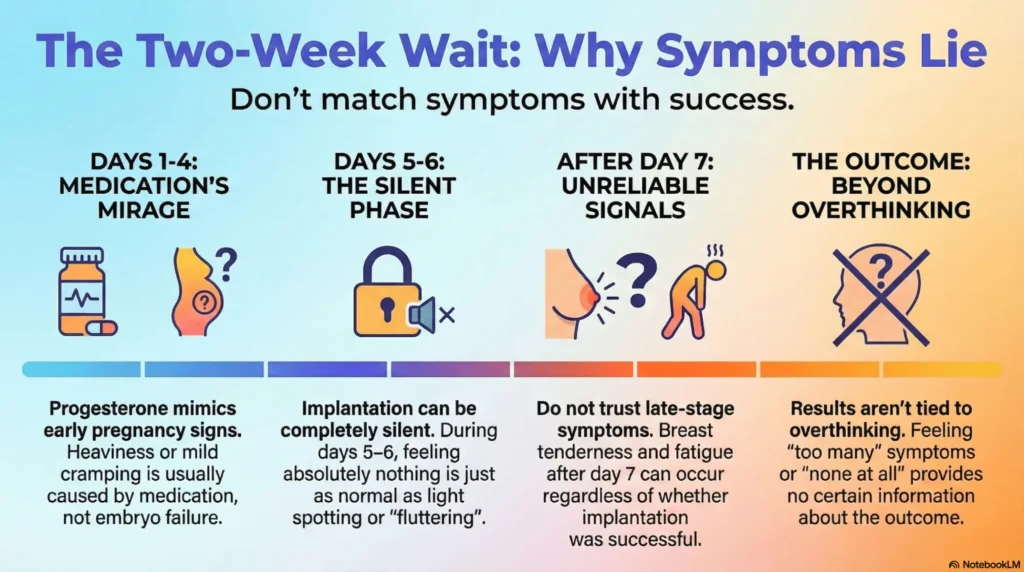
Day 1-2: “Should I be feeling something?”
Short answer? No.
Most patients feel:
- Nothing
- Or just a little heaviness
Some tell me:
“Lower abdomen mein thoda full feel ho raha hai.”
That’s usually not the embryo.
That’s your progesterone medicines.
So if you feel nothing… good.
If you feel something mild… also fine.
Nothing to decode yet.
Day 3-4: “It feels like my periods are coming…”
This is where overthinking begins.
Inside your body, the embryo is preparing to attach.
And you might feel:
- Light cramps
- A pulling sensation
- Gas, bloating
Many patients say this exact line:
“Doctor, pakka periods aane wale lag rahe hain.”
Let me stop you right there.
This feeling is very common.
And it does NOT mean your cycle has failed.
Day 5-6: “Something feels different… or may be not?”
This is usually the implantation window.
Now listen carefully.
Some women feel:
- Very mild spotting
- Light cramps
- A strange “flutter” or movement feeling
And some feel absolutely nothing.
Both are normal.
This is where people go wrong.
They try to match symptoms with success.
It doesn’t work like that.
Day 7-9: “Now I’m noticing everything”
At this stage, if implantation has occurred, your body begins to react.
You might notice:
- Breast tenderness
- Feeling sleepy
- Low energy
And instantly the thought comes:
“Is this a good sign?”
Maybe. Maybe not.
Because the same symptoms come from progesterone.
So don’t trust symptoms blindly.
Day 10-12: “Now I’m really overthinking”
This is the toughest phase.
You either feel:
- Too much
- Or nothing at all
And both situations scare you.
Patients tell me:
“I have no symptoms… I think it failed.”
Or
“I have so many symptoms… I think it worked.”
Let me be very clear.
Neither tells you anything for sure.
No Symptoms After Embryo Transfer - Let’s Clear This
This is the biggest fear.
So I’ll answer you directly.
Having no symptoms at all is completely normal.
I have seen many successful pregnancies where:
- No cramps
- No spotting
- No breast pain
Nothing.
And still, the result was positive.
So if your body feels quiet…
It doesn’t mean nothing is happening.
Let’s Talk About “Misleading” Symptoms
This is where most stress comes from.
Let me simplify it for you.
Feels like periods are about to start?
Very common. Not a bad sign.
Breast pain?
Mostly hormone-related.
Spotting?
It can happen in both success and failure.
No symptoms?
Still completely okay.
See the problem?
Everything overlaps.
That’s why symptoms confuse more than they help. For those of you who are curious and want to read more about these positive signs of a successful embryo transfer, we have covered it in detail in our earlier blog.
About cramps… because everyone asks this
Yes, cramps happen.
Some describe it as:
- Pulling
- Pressure
- Light pinching
And immediately they ask:
“Good sign hai kya?”
Honestly… it could be anything.
Implantation. Hormones. Even a normal uterine response.
So don’t assign meaning too quickly.
When should you actually worry?
Most things you feel are harmless.
But call your doctor if you have:
- Severe pain
- Heavy bleeding
- Fever
Otherwise, your body is just doing its job.
Now the real challenge: the 2 - week wait
This is not physical. It’s mental.
You’ll feel like:
- Checking symptoms every hour
- Googling every sensation
- Comparing with others
Try not to.
Seriously.
Instead:
- Take your medicines properly
- Keep yourself busy
- Talk to someone you trust
And one thing I always tell my patients:
“Don’t try to feel pregnancy.”
It doesn’t give signals like that.
So when will you actually know?
Wait till 10-14 days after the embryo transfer. Then, after that, do a blood test or sonography to confirm a pregnancy.
When Should You Have a Blood Test After an Embryo Transfer?
This is the one question every patient asks me.
And I get why.
You just want clarity. Fast.
But here’s where I need you to slow down a bit.
When is the right time?
Ideally, the beta hCG blood test should be done:
- 10 to 14 days after embryo transfer
Not earlier.
I know the temptation.
By day 6 or 7, you start thinking, “Let me just check once.”
But if you test too early, you may get a false negative.
Which means the pregnancy could be there, but the hormone is still too low to detect.
And that creates unnecessary panic.
What Exactly Does This Blood Test Measure?
This test checks the level of hCG (human chorionic gonadotropin) in your blood.
This hormone is produced only after implantation begins.
So if hCG is rising, it means:
→ The embryo has attached
→ Your body has started responding
This is the first reliable confirmation of pregnancy.
What hCG Levels Indicate Pregnancy?
Let me keep this simple.
- Less than 5 mIU/ml → Not pregnant
- Above 25 mIU/ml → Positive pregnancy
- Between 5–25 → Borderline (we repeat the test)
But don’t get stuck on one number.
What matters more is how the value behaves over time.
Why Do We Repeat the hCG Test?
Because one value is just a snapshot.
A healthy early pregnancy usually shows:
→ hCG doubling every 48–72 hours
So we often repeat the test after 2 days.
Example:
- Day 12 → 80
- Day 14 → 160 or more
That rise is what reassures us.
What If the Value is Low?
This is where patients get very anxious.
A low value does not always mean failure.
Sometimes:
- Implantation happened late
- Hormone levels are just starting to rise
In such cases, we repeat the test and observe the trend.
So don’t jump to conclusions from a single report.
Why Waiting Before the Test is So Important
Let me be very direct here.
Testing early does more harm than good.
If you test too soon:
- You might not detect hCG yet
- You may think the cycle has failed
- You go through stress for no reason
I’ve seen patients lose hope…
and then come back with a positive result in 3 days.
That emotional rollercoaster is avoidable.
That’s why I always say:
Wait for the right day. Trust the timing.
One Last Thing
Home pregnancy tests are not as reliable this early.
They can:
- Miss early pregnancy
- Show faint lines that confuse you
If you want a clear answer, get a beta-hCG blood test at the right time.
That’s the only result we trust.
Before you go… listen to this once
You’ve already done the hard part.
Now your job is simple:
Wait. Don’t overanalyse. Trust the process.
Your body may feel loud.
Or completely silent.
Both are okay.
We’ll know the answer soon – the right way.
FAQs
Can I feel implantation after IVF?
Most women don’t feel it. And that’s normal.
Is cramping a good sign?
It can happen in many situations. It’s not a reliable sign.
Why do I feel nothing?
Because symptoms depend on hormones, not just implantation.
Is spotting a positive sign?
Not always. It can happen in both outcomes.