If you’re asking this question, you’re not just curious.
Most couples sitting in front of me ask this after one failed IVF cycle… or when they’re about to start and already thinking ahead.
There’s always a pause before they ask.
“Doctor… kitni baar try kar sakte hain ek saal mein?”
Behind that question, I usually hear three things:
- “Do I still have time?”
- “How many chances do I really get?”
- “What if it doesn’t work again?”
As an IVF specialist in Ch Shambhajinagar, I hear this question often. Let me answer this clearly.
First, Let’s Correct the Question
IVF is not counted like:
“You can do 3 cycles per year, and you’re done.”
That’s not how medicine works.
The real question is:
“When does it make sense to repeat IVF?”
Because doing more cycles blindly is not a strategy.
It’s just repetition.
And repetition without understanding failure often leads to the same result.
So, How Many IVF Cycles Can You Do in a Year?
In real-world practice, most patients go through 2 to 3 IVF cycles in a year.
But I want you to be careful with this number.
This is not a rule.
This is not a target.
And definitely not a guarantee.
Some patients do only one cycle and succeed.
Some need more than three, but with changes in approach.
Some are advised to pause after one failed attempt.
So instead of asking:
“How many cycles per year?”
Start thinking:
“What did we learn from the last cycle, and what changes now?”
Can You Do IVF Back-to-Back Every Month?
Technically, yes.
Medically, not always wise.
Your body goes through intense hormonal stimulation during IVF. Your ovaries are pushed to produce multiple eggs. After that, your system needs time to settle.
If we rush into the next cycle:
- Egg quality may drop
- Hormonal balance may not recover
- The same mistakes may repeat
So yes, you can do IVF every month.
But in most cases, you shouldn’t.
What Decides the Gap Between Two IVF Cycles?
There is no fixed “30 days” or “60 days” rule.
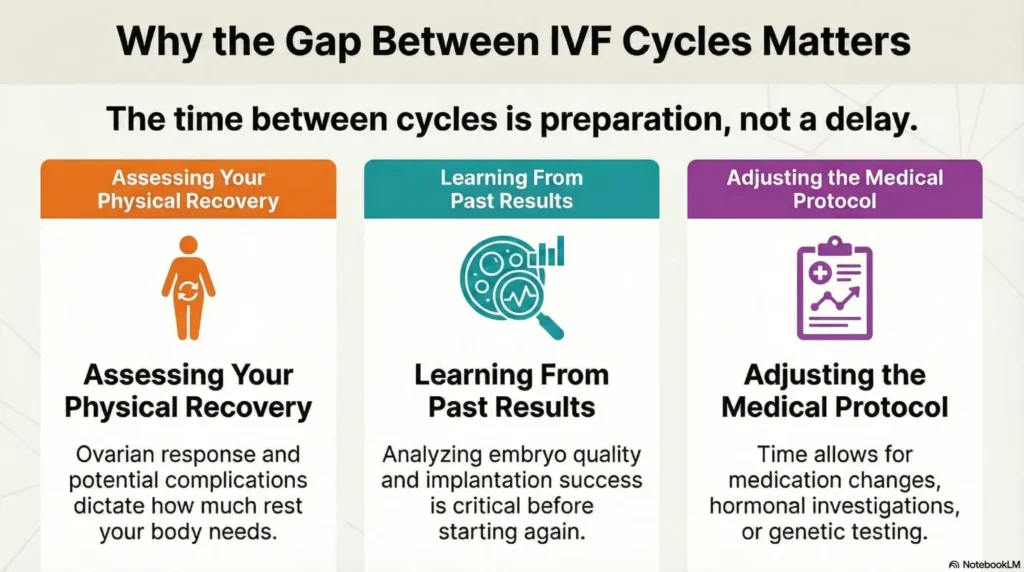
I decide the gap based on three things:
1. How Your Body Responded
If your ovaries responded poorly or you had complications, we need recovery time.
If the response was good, we may proceed sooner.
2. What Happened in the Last Cycle
This is critical.
- No eggs retrieved?
- Poor embryo quality?
- Embryos formed, but no implantation?
Each situation needs a different plan.
Repeating the same cycle without understanding this is a mistake.
3. What Needs to Change
Sometimes we need to:
- Adjust medications
- Change stimulation protocol
- Investigate the uterus or hormones
- Consider genetic testing
All this takes time.
And that time is not a delay.
It’s preparation.
Does Doing More IVF Cycles Increase Success?
This is the biggest misconception.
Many people believe:
“If I keep trying, eventually it will work.”
Partially true. But incomplete.
Yes, cumulative success improves with each IVF cycle. If you wish to read more about success rates in the first IVF cycle, we have covered this in an earlier blog.
But success does NOT increase in a straight line.
If the same problem exists in every cycle, repeating cycles won’t fix it.
Let me say this clearly:
More cycles do not guarantee success. A better strategy does.
What Should Change After a Failed IVF Cycle?
If your IVF cycle fails, the next step is not “try again quickly.”
The next step is:
Understand why it failed.
We look at:
- Egg quality
- Embryo development
- Sperm factors
- Uterine environment
- Hormonal balance
Sometimes small changes make a big difference.
Sometimes we need a completely different approach.
But if nothing changes, the outcome rarely changes.
When Should You Pause IVF Instead of Continuing?
This is where many couples struggle.
There is pressure. Emotional. Financial. Family.
But medically, there are clear situations where pausing is better:
- Repeated IVF failures without a clear reason
- Very poor ovarian response
- Consistently poor embryo quality
- Physical exhaustion
- Emotional burnout
Taking a break doesn’t reduce your chances.
In many cases, it improves your next attempt.
Think of it like this:
Pause is not giving up. It’s resetting the plan.
How Many Failed IVF Cycles Are Too Many?
There is no fixed number.
But patterns matter.
- 1 failed cycle → very common
- 2 failed cycles → still within expectation
- 3 or more → we need a deeper evaluation
At this stage, continuing blindly is not the answer.
You need:
- Reassessment
- Strategy change
- Sometimes a second opinion
Because:
More attempts without answers is not persistence. It’s a risk. You must take into consideration how your body reacts after each failed IVF cycle.
Does Age Affect How Many IVF Cycles You Can Do?
Yes. But not in the way most people think.
- Younger patients usually have better ovarian reserve
- Older patients may need faster decisions
But age alone does not decide everything.
I have seen:
- Younger patients with poor response
- Older patients with surprisingly good outcomes
However, you must know that by age 30, you’ve lost 90% of your eggs. By 35, miscarriage risk doubles.
So instead of focusing only on age:
Focus on how your body is responding to treatment
What Happens If You Do IVF Too Frequently?
If cycles are rushed without proper planning, you may face:
- Poor egg quality
- Lower success rates
- Hormonal imbalance
- Emotional exhaustion
- Financial stress
Many couples think:
“Let’s finish all attempts quickly.”
But IVF is not a race.
Speed without direction often leads to disappointment.
The Financial Reality No One Explains Clearly
IVF is not just one cycle.
It is a journey.
And financial planning matters.
Doing multiple cycles quickly can:
- Drain resources
- Add stress
- Affect decision-making
Sometimes spacing cycles helps:
- Financial stability
- Better planning
- Emotional recovery
This is not just medical. It’s practical.
What a Good IVF Plan Actually Looks Like
A good IVF journey looks like this:
Cycle → Evaluate → Adjust → Repeat (if needed)
Not:
Cycle → Repeat → Repeat
Each cycle should give you information.
That information should change your next step.
That’s how outcomes improve.
Red Flags You Should Not Ignore
If you’re undergoing IVF, watch for these:
- The same protocol is repeated again and again
- No clear explanation for failure
- Pressure to continue without discussion
- No plan for “what if this fails again”
You deserve clarity.
Not just treatment.
When Do Doctors Recommend Stopping IVF?
This is not easy to talk about. But it is important.
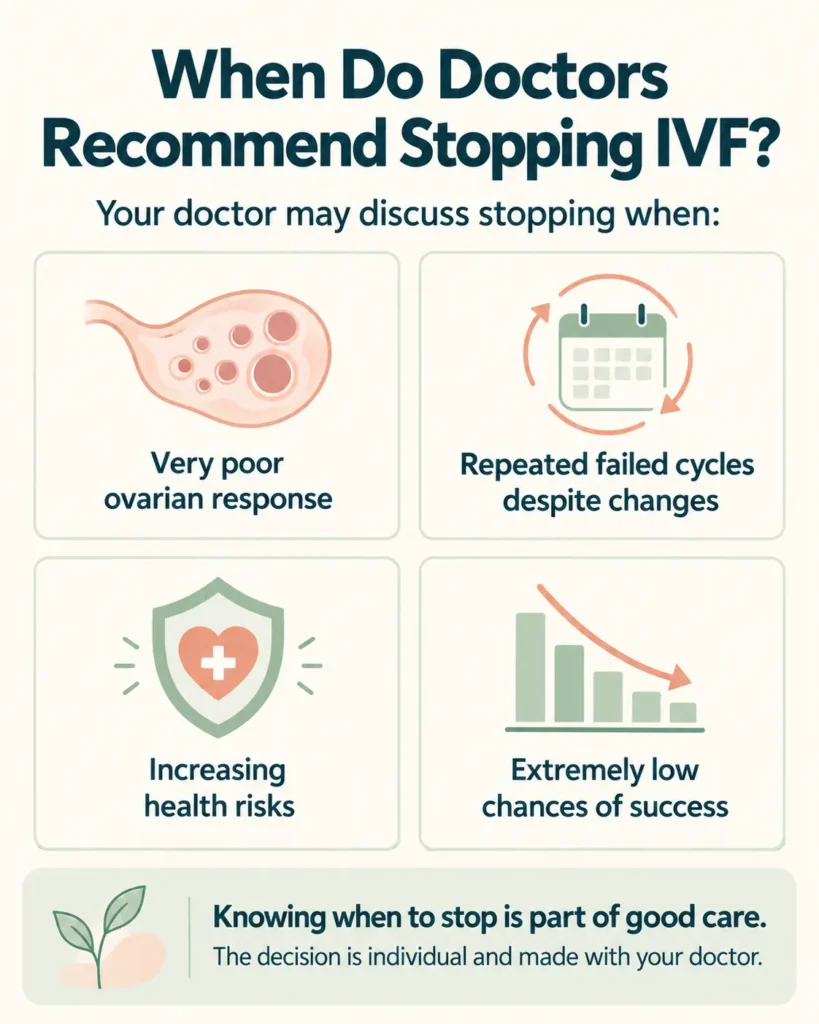
We may advise stopping when:
- Ovarian response is extremely poor
- Multiple cycles fail despite changes
- Health risks increase
- Chances become extremely low
Good medical care is not just about continuing.
It is also about knowing when continuing is no longer helpful.
Alternatives for recurrent IVF failure:
- Proper evaluation of the case and correction of factors causing recurrent IVF failure
- If eggs or sperm are having untreatable problems, we can think of oocyte donation or sperm donation or embryo donation.
- Surrogacy, if uterine or endometrial factors are basic cause of implantation failure
Final Takeaway: Don’t Count Cycles. Make Decisions
If you remember only one thing from this:
IVF is not about how many times you can try in a year.
It is about:
- When to continue
- When to pause
- When to change strategy
- When to stop
Your goal is not to complete cycles.
Your goal is to make each cycle count.
Quick FAQs
How soon can I try IVF again after failure?
Usually after one menstrual cycle, but only if your body and reports support it.
Is it safe to do IVF twice in 3 months?
In some cases, yes. But not for everyone. It depends on recovery and response.
Does taking a break reduce IVF success chances?
No. In many cases, it improves outcomes.
How many IVF attempts are usually needed?
Many couples succeed within 2–3 cycles, but this varies widely.
If you’re going through IVF right now, I know this is not just a medical decision.
It’s emotional. It’s exhausting. And sometimes confusing.
Take it one step at a time.
And make sure every next step is better informed.