If your IVF test result was negative, you are probably asking one question again and again:
What happens to your body after failed IVF?
Not just medically.
Emotionally. Physically. Financially. Mentally.
Let me walk you through this calmly, clearly, and honestly.
1. The Immediate Physical Changes After Failed IVF
When an IVF cycle does not result in pregnancy, the first change your body goes through is hormone withdrawal.
During IVF treatment, you take hormones like estrogen and progesterone to support implantation. Once these medicines are stopped, hormone levels drop suddenly.
This usually leads to:
- A period/menstruation within 1–2 weeks
- Heavier or more painful bleeding
- Clotting
- Fatigue
- Mood swings
This first period can feel more intense than your usual cycle. That does not mean something is wrong. It means your body is recalibrating.
Your ovaries were stimulated to produce multiple eggs. Now they are returning to their natural rhythm.
For most women, the body resets within 4 to 6 weeks.
2. Do Hormones Get Disturbed After Failed IVF?
This is a common fear.
From a medical standpoint, most hormonal changes after a failed IVF cycle are temporary. Your reproductive system gradually stabilises.
However, if you search online for “failed IVF experiences,” you will find very raw discussions on public fertility forums and Reddit communities.
Women there describe things like:
“Thyroid was normal at start and is now almost at 4.”
“IVF messes up your hormones BAD.”
Some mention acne, changes in facial hair, or weight gain.
It is important to understand context.
Online forums often become safe spaces for women who are struggling. Those who recover smoothly rarely write long emotional posts. So what you read can represent more difficult experiences rather than typical recovery.
Medically:
- Thyroid changes are possible but not common.
- Acne and mild hair changes are usually temporary.
- Hormone levels typically settle within weeks.
If you notice unusual fatigue, irregular cycles, or weight changes, we advise a simple blood test. Most issues are manageable.
3. Weight Gain and Physical Discomfort
Some women worry that IVF treatment permanently changes their bodies.
On discussion platforms, you may read statements like:
“On my 5th round of IVF… I have scars, muscle aches, acne and 40+ lbs.”
Let us separate emotion from physiology.
Weight gain during IVF usually comes from:
- Fluid retention
- Hormonal stimulation
- Stress eating
- Reduced activity
- Emotional stress
Much of this is reversible once hormones stabilise and emotional stress decreases.
Progesterone injections can also cause:
- Muscle soreness
- Injection-site lumps
- Temporary discomfort
Severe nerve damage is rare, but if pain persists, it should always be evaluated.
Your body is not permanently damaged by one failed IVF cycle.
4. The Emotional Impact After Failed IVF
Now we talk about the real part.
Across global fertility communities, women describe failed IVF in very strong words:
“I feel so traumatised.”
“Guilt that I failed us is unbearable.”
“My mental health is trash.”
These are not medical statements. They are grief statements.
A failed IVF cycle is not just a medical event. It is the loss of expectation. The loss of the future you imagined.
You may feel:
- Sadness
- Anger
- Numbness
- Jealousy of others
- Anxiety about age
- Fear about cost
This does not mean you are weak.
It means you hoped deeply.
And hope is powerful.
5. Financial Stress After Failed IVF
Let us address the practical side.
IVF treatment is expensive. In India, insurance support is limited. A failed IVF cycle can create financial strain.
On public forums, some women openly write:
“We are also in deep financial shit.”
Financial pressure adds another emotional layer. It can create tension between partners. It can increase anxiety about trying again.
This is why decision-making after failed IVF must be structured, not emotional.
At Endoworld Hospital in Chhatrapati Sambhajinagar, we do not rush couples into immediate repeat cycles. We review data first.
Failure is information. And information guides strategy.
6. Does Failed IVF Mean You Cannot Conceive?
No.
A failed IVF cycle does not mean:
- You are infertile forever
- Your body rejected the pregnancy
- You will never become a mother
Sometimes the embryo did not implant.
Sometimes chromosomal issues occurred.
Sometimes timing or endometrial factors played a role.
Even on online communities, you will find stories like:
“My first transfer was a 3AA and failed. Second, used the same protocol for a 3B, and it worked.”
And surprisingly:
“In between deciding on a fourth round… I got a positive pregnancy test.”
Natural conception after failed IVF is not common, but it is possible. More often, adjusting the IVF treatment protocol improves success rates.
That is why post-cycle review matters.
7. What Should You Do After a Failed IVF Cycle?
Here is a clear roadmap.
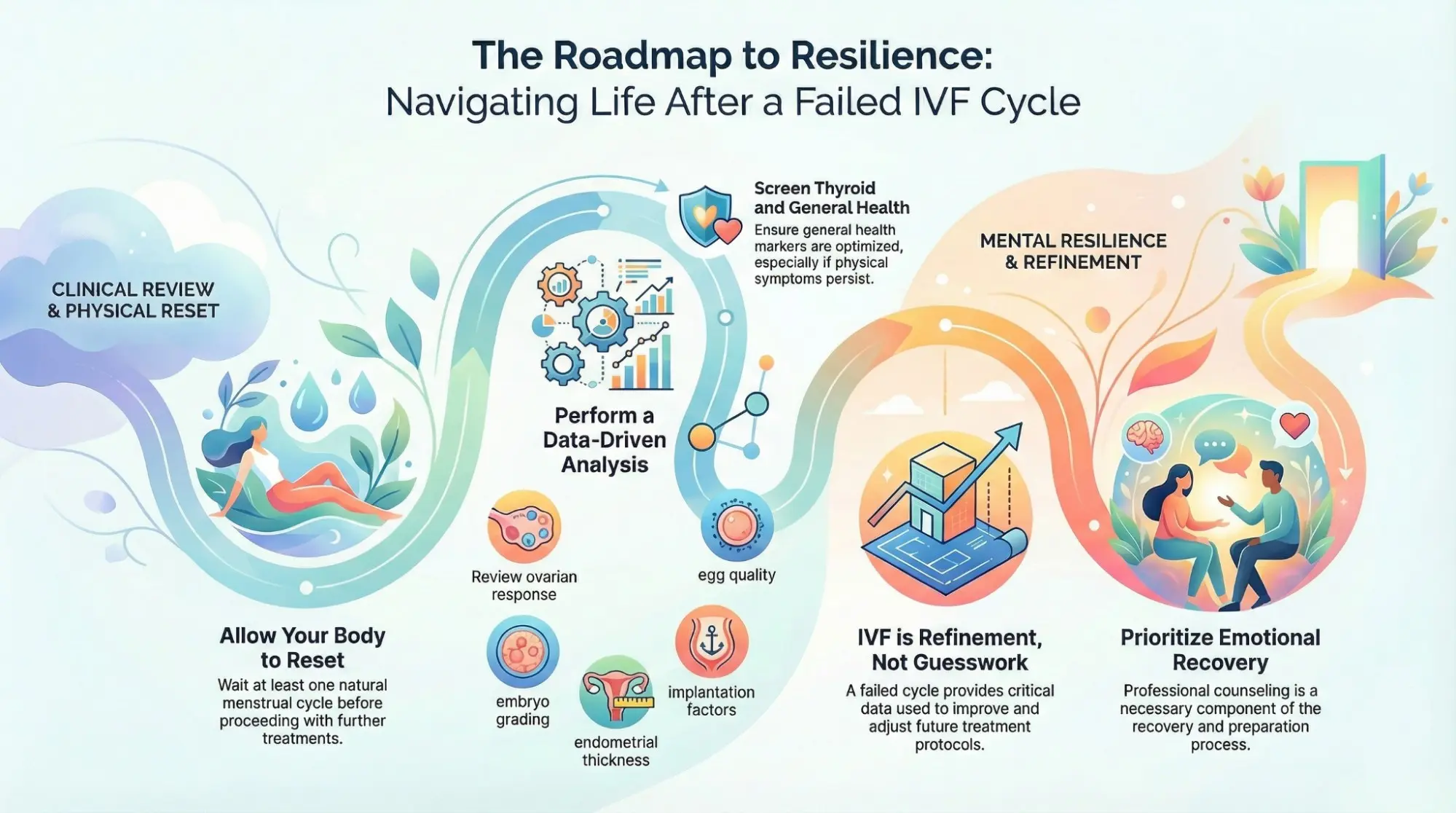
8. How Long Does It Take to Feel Normal Again?
Physically:
Most women stabilise within 2 to 6 weeks.
Emotionally:
There is no fixed timeline.
Do not compare your healing with stories online. Everyone’s nervous system processes loss differently.
9. Should You Try Another IVF Cycle?
This decision depends on:
- Your age
- Ovarian reserve
- Embryo quality
- Financial planning
- Emotional readiness
Cumulative IVF success rates improve over multiple cycles. But repeat cycles should be strategic, not desperate.
At Endoworld Hospital, we personalise IVF treatment plans based on evidence, not pressure.
A Final Word
If you searched “what happens to your body after failed IVF,” you are likely sitting in uncertainty right now.
Let me say this clearly.
Your body is not broken.
You did not fail.
The cycle failed.
That is different.
Recovery is possible. Strategy can change. Outcomes can improve.
If you are in Chhatrapati Sambhajinagar and want clarity about your next step after failed IVF, consult our fertility team at Endoworld Hospital.
You deserve answers.
You deserve a plan.
And you deserve care that understands both your body and your heart.