She had already read everything.
The clinic websites. The forums. The success stories.
Still, sitting in a consultation room, she asked a quiet question that many patients ask.
“Can you just tell me the stages?”
She was not asking for medical details.
She was asking whether she could emotionally survive this.
That question sounds simple. It is not.
When people search for what are the 5 stages of IVF, they are rarely asking how IVF works. They are trying to understand how the journey will feel, where it will get hard, where control will be lost, and whether they will know what is coming next.
The idea of “stages” exists because uncertainty is heavy. IVF carries physical effort, emotional risk, financial strain, and long waiting periods. Breaking it into stages gives the mind something to hold on to.
But it is important to say this clearly.
The five stages of IVF are not guarantees.
They do not predict outcomes.
They help with expectations, not certainty.
Understanding that difference matters, especially for those starting IVF for the first time and those returning after a previous cycle.
Why IVF Is Commonly Explained in Stages
IVF is not a straight path. From a medical point of view, it is adaptive. Plans change based on how the body responds. Decisions are reviewed constantly.
From a patient’s point of view, IVF feels overwhelming.
Too many appointments.
Too many decisions.
Too much waiting.
Stages exist to make the process mentally manageable. They create structure where there is emotional chaos. They help patients feel oriented, even when outcomes remain uncertain.
For first-time patients, stages answer the question, “What comes next?”
For repeat-cycle patients, they often answer differently: “Will this feel the same again?”
Both questions are valid. Neither has a simple answer.
What Are the 5 Stages of IVF and What Do They Actually Explain?
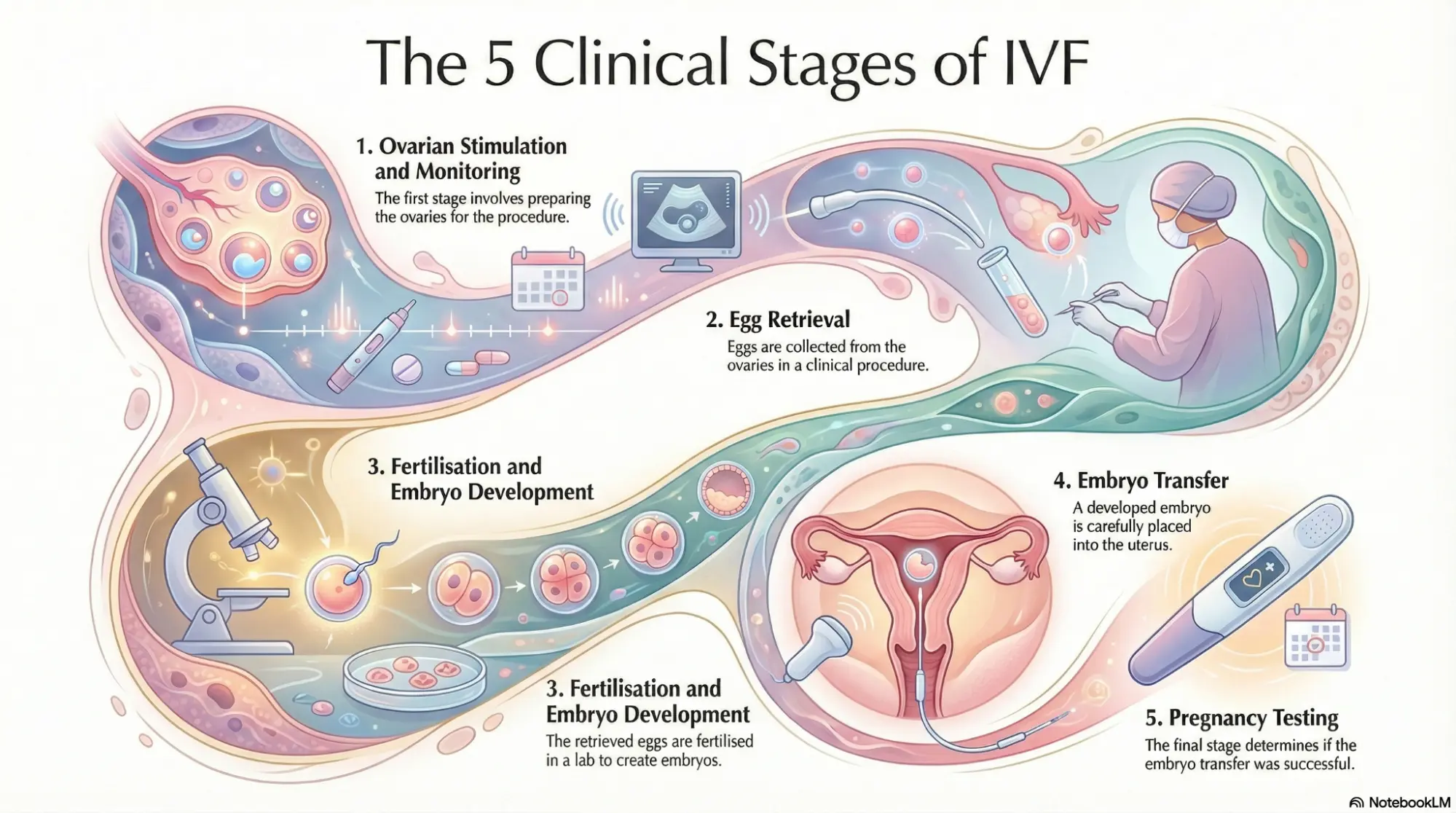
Clinically, IVF is often described in five stages:
- Ovarian stimulation and monitoring
- Egg retrieval
- Fertilisation and embryo development
- Embryo transfer
- Pregnancy testing
These stages are best understood as emotional checkpoints rather than technical steps. Each stage changes what patients are asked to carry mentally.
Stage 1: Ovarian Stimulation and Monitoring
For first-time patients, this stage often feels like crossing a line. IVF becomes real. Conversations turn into action.
For those who have been through IVF before, this stage can feel familiar, sometimes uncomfortably so. Memories of previous cycles may return early.
This stage prepares patients for active involvement. IVF begins to take up mental space. Appointments, planning, and coordination become part of daily life.
The effort here is not physical difficulty. It is emotional attention. Watching the body closely can bring hope, anxiety, or both.
What remains undecided is how the body will respond. Even experienced patients do not know this in advance.
Starting again does not mean starting with certainty.
Stage 2: Egg Retrieval
This stage often marks a shift in control.
Until now, patients have been actively involved. Here, responsibility largely lies with the medical team. For many, this brings relief. For others, it brings vulnerability.
First-time patients may feel nervous about the unknown.
Repeat-cycle patients may carry expectations shaped by past experiences.
The effort in this stage is brief but intense. Emotionally, it is about trust. Patients must rely on decisions they cannot influence.
What remains open is the outcome. Egg retrieval does not secure the rest of the cycle. It is one moment, not a turning point.
Stage 3: Fertilisation and Embryo Development
This stage is often the hardest to describe because it feels invisible.
Most of the work happens out of sight. Patients wait for updates, doing nothing. For first-time patients, this can feel unsettling. For those returning, the waiting can feel heavier because they know how much is at stake.
What this stage demands is emotional restraint. Hope exists, but so does distance. Many patients struggle with not knowing how much to think ahead.
What remains undecided is whether plans continue or change. IVF does not move forward simply because earlier stages were completed.
Stage 4: Embryo Transfer
Emotionally, this stage is often misunderstood.
For many patients, especially those trying for the first time, embryo transfer feels like being close. Hope rises sharply here.
For repeat-cycle patients, this stage can bring mixed emotions. Hope may exist alongside caution or fear of disappointment.
The effort required is mental balance. Managing expectations without shutting down emotionally is difficult.
What this stage does not mean is certainty. Transfer is not a finish line. It is another pause point.
Stage 5: Pregnancy Testing
This stage carries the most emotional weight.
By this point, patients have invested time, energy, and hope. Waiting for results can feel longer than any procedure.
For first-time patients, this may be their first real encounter with IVF uncertainty.
For repeat-cycle patients, this stage often carries emotional memory.
What this stage represents is exposure. Not answers. Not closure.
Even outcomes do not end uncertainty. They change their shape.
What the “5 Stages of IVF” Framework Leaves Out and Why That Matters to You
When clinics, articles, or videos explain IVF in five stages, they are using a simplified framework. The framework itself is not wrong. But it leaves out things that strongly affect how patients experience IVF.
Knowing what is missing helps patients prepare better and judge themselves less harshly.
Here is what the five-stage explanation does not prepare you for.
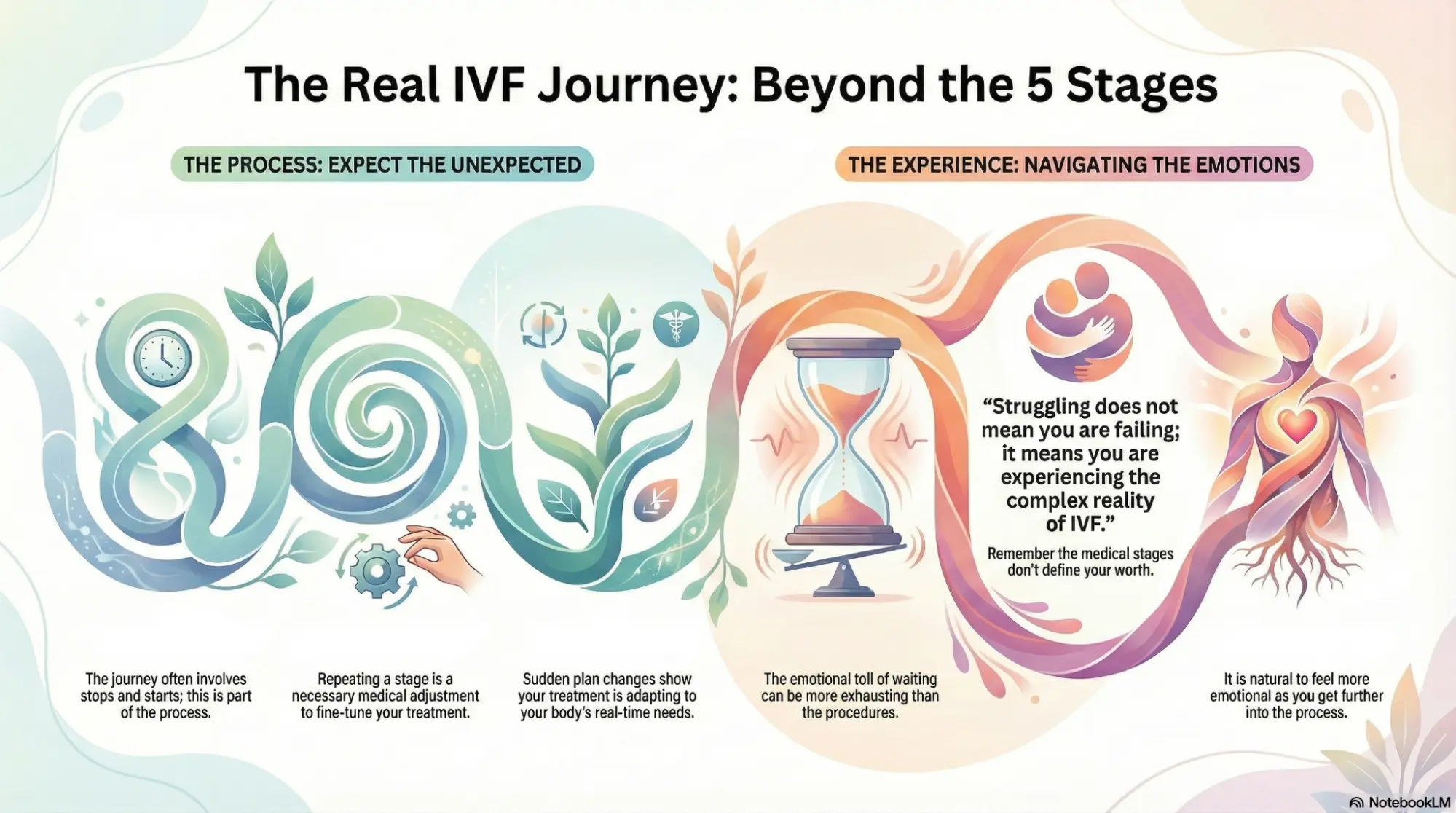
- It does not prepare you for pauses, stops, or reversals.
Stage lists quietly suggest forward movement. In reality, IVF often pauses. Sometimes a cycle stops. Sometimes plans reverse. When this happens, patients often feel shocked or unprepared, not because something went wrong, but because the stage framework never warned them that interruptions are common. - It does not prepare you for repetition.
Stage lists imply that each stage happens once. Many patients feel discouraged when they return to an earlier stage or repeat a part of the process. Understanding in advance that repetition is part of medical adjustment helps patients see this as refinement, not failure. - It does not prepare you for how heavy waiting feels.
Stages focus on events. They ignore silence. Waiting periods often carry more emotional weight than procedures, because there is nothing to do except think. When patients are not warned about this, they may feel surprised by their own anxiety or exhaustion. - It does not prepare you for sudden plan changes.
Stage-based explanations sound fixed. IVF decision-making is not. Plans change because the body responds in real time. When patients expect a fixed sequence, change feels like a loss of control. When they expect flexibility, change feels like care responding to reality. - It does not prepare you for how your emotional response may change over time.
Many patients assume that later stages will feel easier because they are “further along.” Often, the opposite happens. Emotional investment grows with time. Knowing this helps patients avoid judging themselves for feeling more vulnerable later in the process.
The value of understanding these gaps is simple.
It helps you stop asking, “Why am I struggling when things are moving forward?”
And start understanding, “This is part of how IVF is experienced, not a personal failure.”
The stages explain the structure.
They do not explain lived experience. As a patient, you need to be clear about it.
Where Patients Commonly Misinterpret IVF Stages
Many patients assume that moving forward means things are going well. This belief is understandable. It is also incomplete.
Others believe that later stages are emotionally safer. In reality, emotional investment often increases over time.
Some feel that reaching the final stage means being close to certainty. This belief reflects hope, not predictability.
These interpretations are common. They are human. They simply do not tell the whole story.
The Invisible Gaps Between IVF Stages
What makes IVF feel harder than expected is often the spaces between stages.
Waiting periods carry stress.
Decision pauses happen quietly.
External pressures from family, work, and finances intensify.
These gaps are not listed, but they deeply shape the experience.
Who the IVF Stages Help and Who They Don’t
For some patients, stages provide calm. They help planners feel oriented. They reduce fear of the unknown.
For others, stages increase pressure. Outcome-focused patients may feel judged by progress markers.
Different reactions do not mean someone is coping poorly. They reflect different emotional needs.
How Doctors and Patients View IVF Stages Differently
Doctors often see stages as decision checkpoints. Each one helps guide the next clinical choice.
Patients often see stages as markers of progress. Each one feels like a movement toward an outcome.
When these perspectives do not align, frustration can arise. This gap is common and understandable.
How to Use the 5 Stages of IVF Safely
Stages work best as a shared language. They help patients ask better questions and prepare emotionally.
They are not a scorecard.
They are not proof of progress.
They are not a reason to rush forward.
Stages can also be permission. Permission to pause. To ask. To stop if needed.