If you are reading this, you are probably weighing your options. Many couples ask me the same question in the OPD:
“Doctor, what are the chances that IVF will work in the first attempt?”
It is a fair question. IVF is emotionally heavy, financially significant and time-sensitive. You want clarity before you make the decision.
Let me break it down simply and honestly so you know what to expect and how to improve your chances.
Understanding IVF Success Rates: What the Evidence Says
Different global databases report slightly different numbers, but the range is consistent.
Based on data from:
- CDC Assisted Reproductive Technology Reports (USA)
- ECDC & European IVF Monitoring
- IHME Global Burden of Disease fertility metrics
- Cochrane evidence reviews on ART outcomes.
Here is the average picture:
Typical first-cycle IVF success rate:
40 to 60 per cent, depending on your age and diagnosis.
This number often surprises people. Many assume IVF works like a “guaranteed pregnancy button.”
It is not. IVF significantly improves your chances, but no clinic in the world can promise a 100 per cent success rate.
Why IVF Success Rates Vary So Much
IVF outcomes depend on a few core factors. Let me explain the ones that truly matter.
1. Your age
Age is the strongest predictor.
According to CDC and ESHRE data:
- Under 35: 45–55 per cent first-cycle success
- 35 to 37: 35–45 per cent
- 38 to 40: 25–30 per cent
- Over 40: 10–15 per cent
Egg quality declines with age. This is biology, not your fault.
2. Ovarian reserve
Tests like AMH and AFC tell us how many usable eggs we may get.
A higher reserve usually improves the chances of a healthy embryo.
3. Sperm quality
Motility, count and morphology matter. Motility means how well the sperm moves. The count means how many sperm are present. Morphology means the shape of the sperm.
All three affect how easily a sperm can reach and fertilise the egg.
If sperm DNA fragmentation is high, success may drop even with good eggs.
4. Embryo quality
Blastocyst-stage embryos have higher success rates. A blastocyst is an embryo that has grown for about five days. At this stage, it is stronger and more developed. These embryos attach to the uterus more easily, increasing the chances of pregnancy.
Evidence from the Cochrane Library shows blastocyst transfer improves implantation compared to day-3 transfers.
5. Uterine environment
A healthy uterus increases the chance of implantation.
We check for polyps, fibroids and lining issues before transfer.
6. Lifestyle choices
Smoking, severe stress, irregular sleep and high BMI reduce first-cycle success.
Multiple epidemiology findings from IHME GBD and statistical models from HealthData.gov support this.
IVF Success Rates in India: What We See in Real Practice
Indian success rates are similar to global averages, but certain patterns differ:
- Indian women often seek treatment later in life.
- PCOS and endometriosis are common reasons for infertility.
- Male factor infertility is rising, supported by ECDC and IHME trend data showing a global increase in sperm-quality issues.
At Endoworld Hospital, we achieve strong outcomes by tailoring protocols to each patient.
But we stay honest.
The first cycle gives us valuable information.
Even if it fails, it guides us to a stronger second attempt.
What Happens in the First Cycle That Affects Success
Your first IVF cycle is not only about pregnancy.
It is also a diagnostic cycle.
It tells us:
- How your ovaries respond to stimulation
- How many eggs do you produce
- How embryos develop in the lab
- How your body responds to medications
- Whether your lining builds optimally
This information helps us fine-tune the next steps.
Many couples conceive in the second or third cycle because we can adjust based on what we learned.
How to Improve Your Chances of First-Cycle IVF Success
You cannot control everything, but you can improve several factors.
1. Start with a complete fertility evaluation
We look at AMH, AFC, thyroid levels, prolactin, semen analysis and ultrasound markers.
A precise diagnosis improves success.
2. Follow a personalised stimulation plan
One size does not fit all in IVF.
Protocols work better when tailored to your hormone levels and ovarian reserve.
3. Opt for embryo culture till blastocyst when possible
Blastocysts have higher implantation potential, according to Cochrane systematic reviews and Medscape clinical reference.
4. Consider PGT if indicated
PGT (genetic testing) helps select chromosomally normal embryos.
Useful primarily for recurrent IVF failures or women above 35.
5. Address lifestyle concerns early
Small tweaks help:
- Maintain healthy weight
- Reduce caffeine
- Sleep well
- Avoid smoking or alcohol.
- Manage stress
These changes directly impact egg and sperm quality.
6. Choose an IVF centre with good lab quality
Success depends heavily on:
- Embryo culture conditions
- Embryologist expertise
- Equipment quality
This is why success rates differ between clinics, even for similar patients.
What I Tell My Patients at Endoworld Hospital
Let me be direct.
IVF is not a lottery. It is a science.
And the science is improving every year.
Advanced media, time-lapse monitoring, improved stimulation drugs and better embryo selection methods all contribute to higher first-cycle success today compared to earlier decades.
But even with all this progress, IVF remains a partnership between biology and technology.
We do our best.
Your body does the rest.
If you ask me, “Should I expect pregnancy in the first cycle?”
My honest answer is:
Hope for the best.
Prepare for the possibility of a second cycle.
That is the balanced, realistic expectation.
How Many IVF Cycles Do Most Couples Need?
Evidence from:
- Cochrane Library
- NICE Fertility Guidelines (UK)
- StatPearls clinical reviews
Shows the cumulative live-birth rate rises sharply across the first three cycles.
Cumulative success rates:
- After 1 cycle: 45–55 per cent
- After two cycles: 60–70 per cent
- After three cycles: 75–85 per cent
This is why many specialists advise looking at IVF as a 3-cycle process, not a single attempt.
When IVF Works Best on the First Try
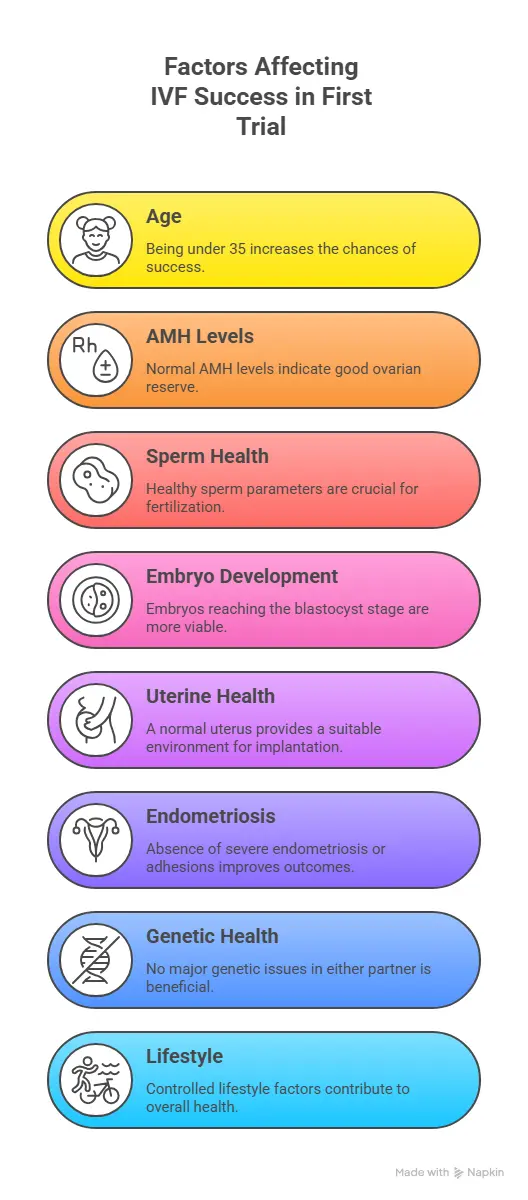
If you fall in this group, your odds are often 40 to 55 per cent or higher.
When IVF First-Cycle Success Is Less Likely
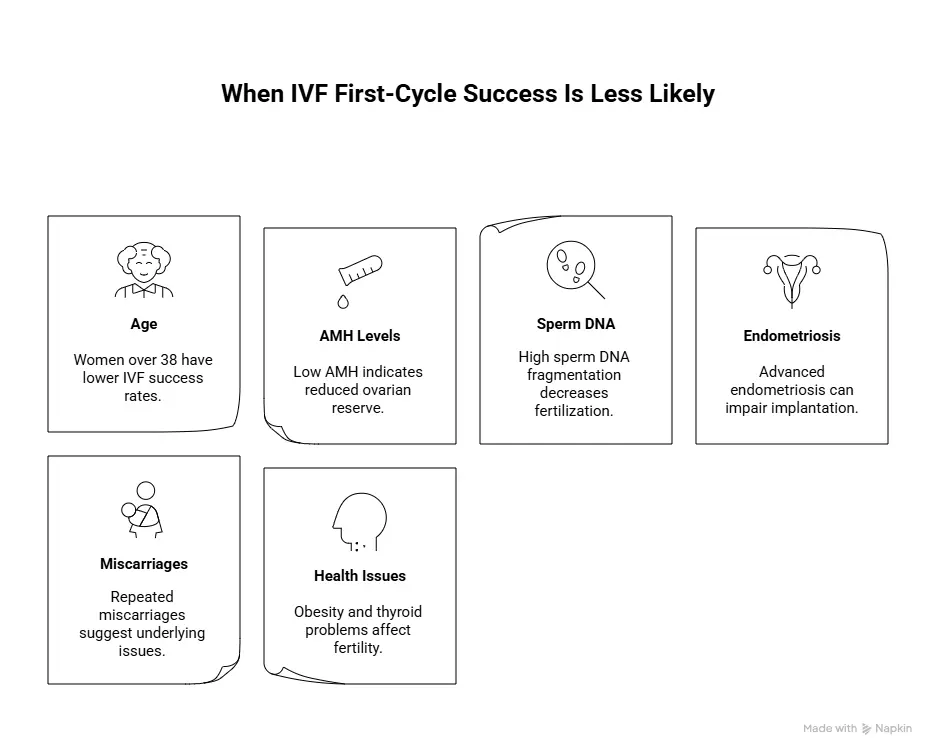
We usually work on optimising health before the next cycle.
The Emotional Side of IVF: What I Want You to Know
Numbers matter.
But you are not a number.
Every couple carries years of trying, frustration and fear before coming to IVF.
I see this every day.
It is normal to feel:
- Anxious
- Impatient
- Hopeful
- Scared of failure
- Overwhelmed by information
You are not alone in this.
Your feelings are valid.
My job is not only to guide the treatment.
My job is also to support you through the process so you can make informed, confident decisions.
Final Takeaway: So, What Is the Real First-Cycle IVF Success Rate?
Here is the simplest, most honest summary:
The first-cycle IVF success rate is usually 30-55%.
It depends heavily on age, egg and sperm quality and embryo health.
But the first cycle also helps us learn what works best for your body.
This information often leads to a stronger second or third cycle, where cumulative success climbs to 70–85 per cent.
The goal is not just pregnancy.
The goal is a healthy baby.
With the right evaluation, personalised protocols and good lab conditions, IVF gives many couples the chance they have been waiting for.